With Stock Market at All Time Highs – What to Do?
Category: Financial and taxes in retirement
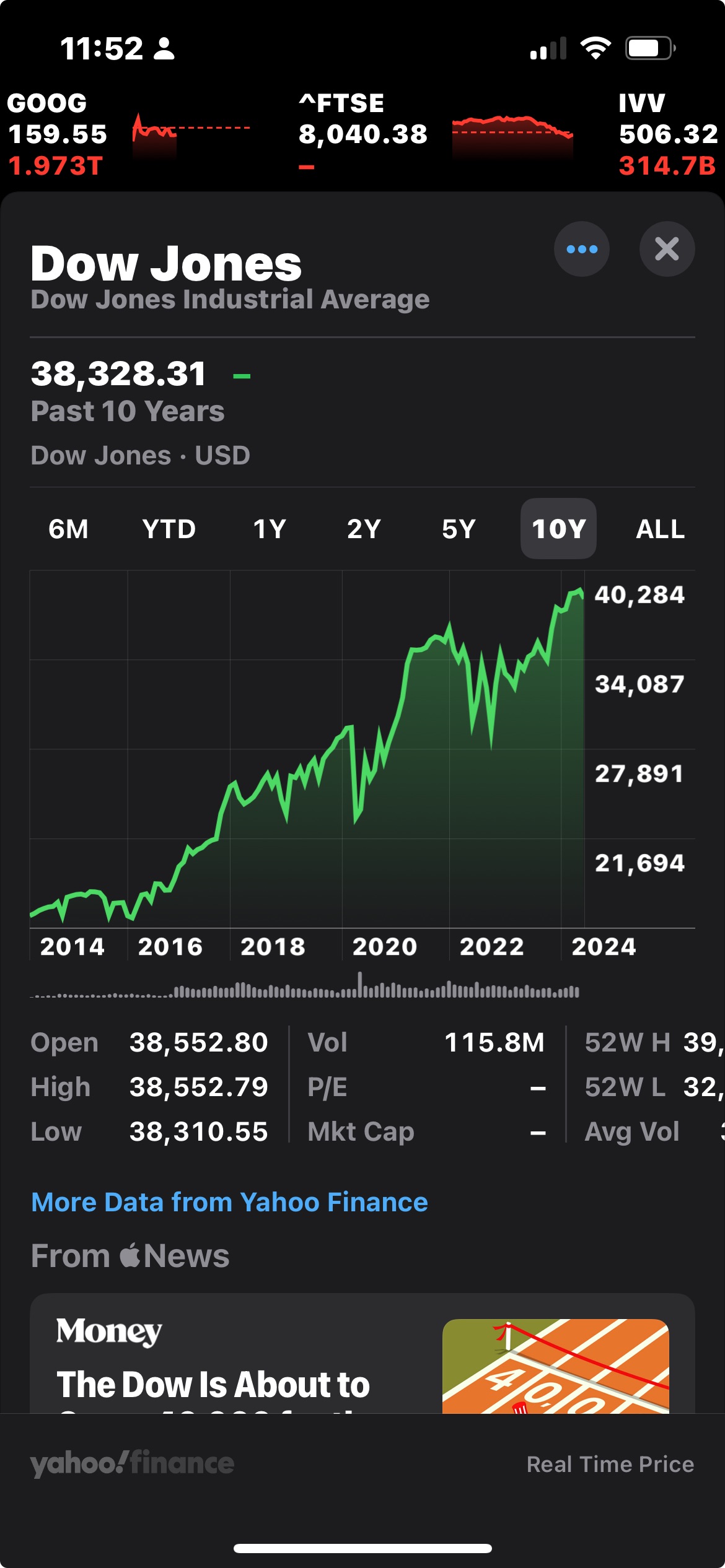
April 20, 2024 — The Dow Jones average is up over 10% in the past year, and the S & P 500 could hit its all time high of 40,000. If you have investments in the stock market that has probably been sweet music for you. But you might be wondering what will happen next – will the market continue to go up, sink like a stone, or just stay the same? Should you buy, sell, or just hold on to what you have? Here are some thoughts for retirees or those approaching retirement.
Safety is important. First, recognize that your investment decisions now have a different weight than they were when you were younger. You now have fewer years to recover, should something go wrong. So protecting your retirement funds should be your first priority. That means rash decisions – like selling everything or going all in – should be avoided at all costs.
Timing the market – nope! One thing that almost all financial experts like Warren Buffett agree upon is that timing the market is just about impossible. No one can predict accurately whether it is going to go up or down in the short term. You can recognize that the market is at an all time high (like it is now) or low, but you can’t know for sure what will come next. The historical record is clear that long term investing pays off. Gradual buying and selling over time is the safest way to avoid a catastrophe.
Diversification. Investors, no matter how far they are from retirement, need a diversification strategy. That means there should be a balance in your asset allocation between equities (stocks), fixed income (including bonds, T-bills or CDs), and cash equivalents (savings or cash management accounts). That allocation should change as you age and approach retirement – when riskier investments should get smaller and the proportion of safer investments like cash get higher. That also means avoiding a concentration in one stock or type of equity. If something goes wrong, you don’t too want too many of your eggs in one investment.

If you need to take money out – what should you do?
With the market so high, what is the best withdrawal strategy? Assuming you are old enough to have to take Required Minimum Distributions (RMDs) from your IRAs and 401(k)s, the first funds you withdraw should be to meet those obligations and avoid penalities. You must start taking RMDs by April 1 of the year after you turn 73. But assuming you own a range of investments, which type should you take out first?
RMDs start out as a fairly low percentage, so any decision you make is not going to be that crucial. For example, at age 73 the divisor is 24.7 – divide your balance by that number to get that year’s withdrawal percentage (4%). Most mutual fund companies allow you to withdraw from specific investments, or to take a percentage from some or all of them. Here is where you can probably afford to make a small timing decision without a big impact.
For example, you could say that since the stock market is at an all time high, it might be a good idea to withdraw from one or more of your equity funds or stocks, rather than from a bond or cash account. Assuming that doesn’t knock your asset allocation out of whack, that might be a good idea. In fact, with the market so high, your equity allocation share might already be higher than it should be!
How about discretionary changes to your portfolio? Assuming you have already withdrawn this year’s RMD, or don’t have to take one, should you switch investments in reaction to a record stock market (timing)? Keeping in mind safety and diversification, the two other points we made at the top, it might be OK to make some small adjustments. For example, if the market’s rise has thrown your asset allocation out of whack in favor of equities, this could be an ideal time to sell some of them to get that diversification allocation back on track. Likewise, if one or more of your funds or stocks has had a really good run, trimming it back to its normal portfolio percentage might be wise.
One advantage with appreciated retirement assets in IRA or 401(k) accounts is that you won’t have to pay capital gains, provided you leave the proceeds there. So if you do trim some of your winners, those are the accounts to do it in.
Bottom line
Deciding what to do when stocks are high is a tricky decision. If you sell and then the market goes down, you were smart. If it then goes up, you might not be able to get back in. If you do nothing, Warren Buffett would probably approve – long term investments are usually the best plan. So whatever you do – keep safety, diversification, and timing in mind. It might be a good idea to use a record stock market to restore balance to your asset allocation. Just avoid being rash, and think long term – over the years the stock market only goes up – eventually!
Comments? Have you been thinking about the stock market and how high it has gone. Are you tempted to sell – or buy? Please share your thoughts in the Comments section below.






Comments on "With Stock Market at All Time Highs – What to Do?"
Admin says:
One investment suggestion is the Rule of 120. Subtract your age from 120 to get the % that should be invested in equities. So if you are 75, 45% of your retirement assets should be in stocks and equity mutual funds. Another idea related to diversity is how much should be international investments - it is usually a good idea to have a small percentage there as well as U.S. related. Of course there is my mother's case. When she died at age 102 about 90% of her investments were in equities - and her heirs were happy with the result!
RichPB says:
Not surprisingly, that Rule of 120 has changed from the Rule of 100. And it makes a big difference! At 75, the rule used to cut that result (25% equities, not 45%). That reflects the increasing life expectancy with consequent likely longer retirements. With today's prices, limiting growth potential in equities could really limit retirement earnings and life options. Paying attention to any investment strategies is critically important as all this indicates.
Admin says:
I had a friend who panicked in 2008 when the stock market crashed and it seemed like the world was coming to an end. He sold his entire portfolio - and never recovered. He took huge losses and the market when up from there so it became too expensive to buy. Steady as she goes should be your motto.
Clyde says:
The Rule of 120 is something to consider when determining asset allocation among stocks and bonds as we age. Of course, it’s not a hard and fast rule. Unless you’re a very experienced and successful investor, it’s always appropriate to consult a qualified financial advisor (hourly fee-based rather than commission) about your individualized situation. No two retirees’ needs are the same.
Staci says:
Clyde, What’s the rule of 120?
Jay says:
For many of us target date funds are a great way to go. Let the professionals manage your money in a way that theoretically reduces your risk as you near and enter retirement. We keep about half of our retirement savings in these types of funds and honestly they've done nearly as well as our FA's managed account.
Danno says:
The 120-age investment rule states that a healthy investing approach means subtracting your age from 120 and using the result as the percentage of your investment dollars in stocks and other equity investments. Any remainder should become investments in low-risk assets, including certificates of deposit (CDs), bonds, Treasury bills and fixed annuities.
For example, if you’re 30 years old, subtracting your age from 120 gives you 90. Therefore, you would invest 90% of your retirement money in stocks and 10% into more consistent financial instruments. This rule creates a portfolio that gradually carries less risk.
On the other hand, if you’re 75, the rule’s formula gives you 45. So, you’d have 45% of your portfolio in stocks and the rest elsewhere. This balanced approach makes sense because you’re likely retired at 75 and looking to stabilize your income. That said, the rule still keeps almost half your portfolio in stocks at retirement age, which is a more aggressive approach than investors followed not too long ago.
RichPt tB says:
Jay, Targets date funds are a good option, but when retirement (and after) arrive, take a new look at least annually to ensure you remain invested appropriately. Most td funds are designed to stay fixed at that point. You may well have different needs at 80 than at 65.