GE: Net Zero Energy Homes by 2015
Category: Green Retirement Communities
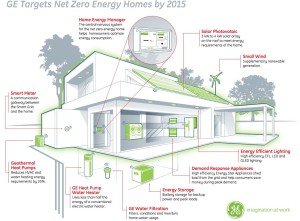 Interested in building or refitting your retirement home so that it’s green? General Electric (GE) announced last month that by 2015 it will have developed the products needed to let new home builders and existing homeowners manage and generate electricity for overall net zero annual energy. If achieved, that means that you will have a zero energy bill! GE will get to that goal through its current portfolio of energy-efficient lighting and appliances products, demand response technology, and residential power generation products like solar PV and residential wind products.
The GE net zero energy home offerings will come from three major groups within the product portfolio: energy efficient products, energy management products and energy generation/storage products.
Energy Efficiency Products: GE’s portfolio of energy- efficient appliance and lighting products will help enable the net zero energy home by reducing energy consumption in the home.
Energy Management/Demand Response Appliances: GE demand response products will help consumers to manage their costs and energy consumption while helping reduce utility demand peaks, thereby reducing the need for more power generation – depending on utility participation.
- GE plans to be the first manufacturer to offer a full suite of demand response appliances that will work with utility smart meters to help shed load from the grid, while helping consumers save money during peak demand usage and pricing times. GE appliances and products will work with smart meters to delay or reduce energy use without major interruption to consumer’s lifestyles by giving the consumer control over their energy use. Residential housing consumes 37 percent of the electricity produced in the US. Appliances, Lighting and HVAC represent 82 percent of electricity consumed in the home.
- As the second single largest energy users in the home, incorporating highly efficient water heaters into net-zero energy builds is critical — and the choice of installer matters just as much as the unit itself, something contractors in California like https://www.whitegloveplumbingca.com have been fielding questions about as heat pump technology moves from niche to mainstream. GE addressed that demand directly by offering its innovative GE Hybrid Electric Heat Pump Water Heater with demand response technology beginning in late 2009. The unit is designed to consume approximately 2,300 kWh per year — less than half the energy draw of a standard 50-gallon tank water heater, which typically pulls around 4,800 kWh annually. That gap of roughly 2,500 kWh per year translates to approximately $250 in annual savings at a rate of 10.65 cents per kWh, a figure that meaningfully advances the math on net-zero viability.
- In 2010 GE will introduce the Home Energy Manager – the central nervous system for the net zero energy home that will work in conjunction with all the other enabling technologies in the home to help homeowners to optimize how they consume energy. In addition to the Home Energy Manger, GE will introduce a line of smart thermostats, also available in 2010.
Distributed Generation/Storage
- Collaborating with GE Energy, products like solar PV, advanced energy storage, next generation thin film solar, small wind will help GE reach its zero energy goal.
What do you think? Is zero energy in your home a worthwhile goal – or something you could care less about? Let us know in the Comments section below.





Comments on "GE: Net Zero Energy Homes by 2015"
says:
My "planning" folder is stuffed with "Net zero" articles (both energy and carbon footprint). I look at it as an investment against inflation - which is the surest way to outlive a portfolio; not to mention a personal sustainability goal.
The big question is whether the capital investment costs will make the implementation impossible.
Solar Panel says:
Get plan! I ll refer you.
Automated ZED says:
I think that ZED coupled with automation is the qintisential home now. The smart ZED home will be the nerve center for all home activities, appliances, automobile and medical diagnosis.
rob earl says:
I'll wait to see what the end result of all this hype brings. Zero sounds great. But the reality is often significantly less than zero, especially in regard to energy efficiency. All too often the capital investment costs are simply too great for practical application. Much has also been said about smart energy meters and appliances that tap the grid at the most economical times. That's all well and good but much of what we do each day happens to coincide with what others are doing at the same time. I don't see much of a radical change in that, unless you want to live a nocturnal existence. Show me.
MylesJ says:
Look up Shea homes for their zero homes, net energy usage of zero. They have been building these for several years