Temperature Turns up on Social Security Reform
Category: Social Security
Average Benefit Could be Cut Almost $500 in 2023
Nov. 30 — Social Security makes for poisonous, treacherous politics. With potential cuts to benefits looming in 2032, the conversation is getting even more heated. But at least Congress is talking about fixing the problem.
There was a fierce partisan clash this week when Senate Budget Committee Chairman Ron Johnson (R-WI) called Social Security a “Ponzi scheme” during a Fox Business interview. Democrats erupted, accusing Johnson of scare tactics and being unwilling to fix a financial crisis that could affect more than 72 million Social Security beneficiaries.
Sen. Mark Warner (D-VA) slammed Johnson for his comments. “Don’t go out there scaring Americans to make political points on Fox News. This is too fricking important.” Later, during the hearing, Johnson acknowledged that his comments about Social Security being impossible to fix had been imprecise.
The Good News
There are at least some proposals to fix the problem, long overdue. One bipartisan idea would eliminate the cap on earnings subject to the Social Security payroll tax, making all earned income subject to the tax instead of just the first $192,300 in 2027.
Another bipartisan proposal would require the Social Security Advisory Board to recommend legislation that would ensure Social Security is funded for at least the next 50 years. Sounds like a good idea.
The Problem
Pretty much everyone agrees that cutting retiree benefits by 22% would be a disaster. But there is plenty of disagreement about how to prevent it.
Some lawmakers emphasize reducing waste and fraud or encouraging economic growth. Others favor bringing more revenue into the system. Proposals to privatize parts of Social Security have also surfaced over the years.
The real third rail comes with proposals that would raise or eliminate the cap on earnings subject to Social Security taxes or increase the payroll tax rate paid by workers and employers. Raising the retirement age or changing the rules for claiming benefits are other possibilities, although these are controversial too.
As frequent readers have heard me say, something has to be done. More money needs to come into the system, benefits need to be adjusted, or some combination of the two will be necessary to fund promised benefits.
What the 2032 Cuts Might Look Like for You
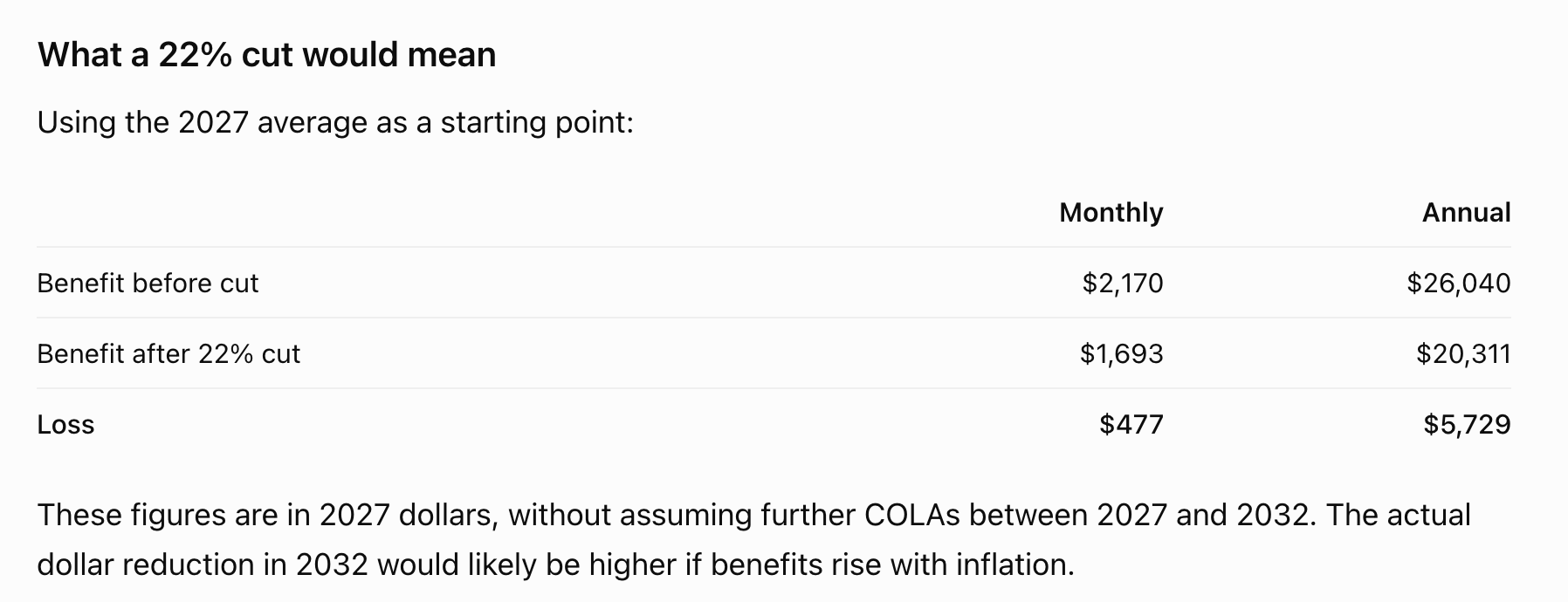
The average retired worker is expected to receive approximately $2,170 per month in Social Security benefits in 2027. If those benefits were cut by 22%, the monthly check would shrink to about $1,693—a loss of $477 per month, or $5,729 a year. For retirees who depend heavily on Social Security, that would be a devastating blow.
These figures are expressed in 2027 dollars. Actual benefits in 2032 would likely be higher because of annual cost-of-living adjustments, making the dollar amount of a potential cut even larger.
And remember, this is not just a threat to future retirees. Unless Congress acts, people already collecting Social Security would also be affected.
The good news is that Social Security would not disappear in 2032. Payroll taxes would continue to fund about 78% of scheduled retirement and survivor benefits. But that would still leave a huge hole in millions of Americans’ retirement budgets.
See Rollcall’s Tempers Flare as Future of SS Discussed in Senate.






Comments on "Temperature Turns up on Social Security Reform"